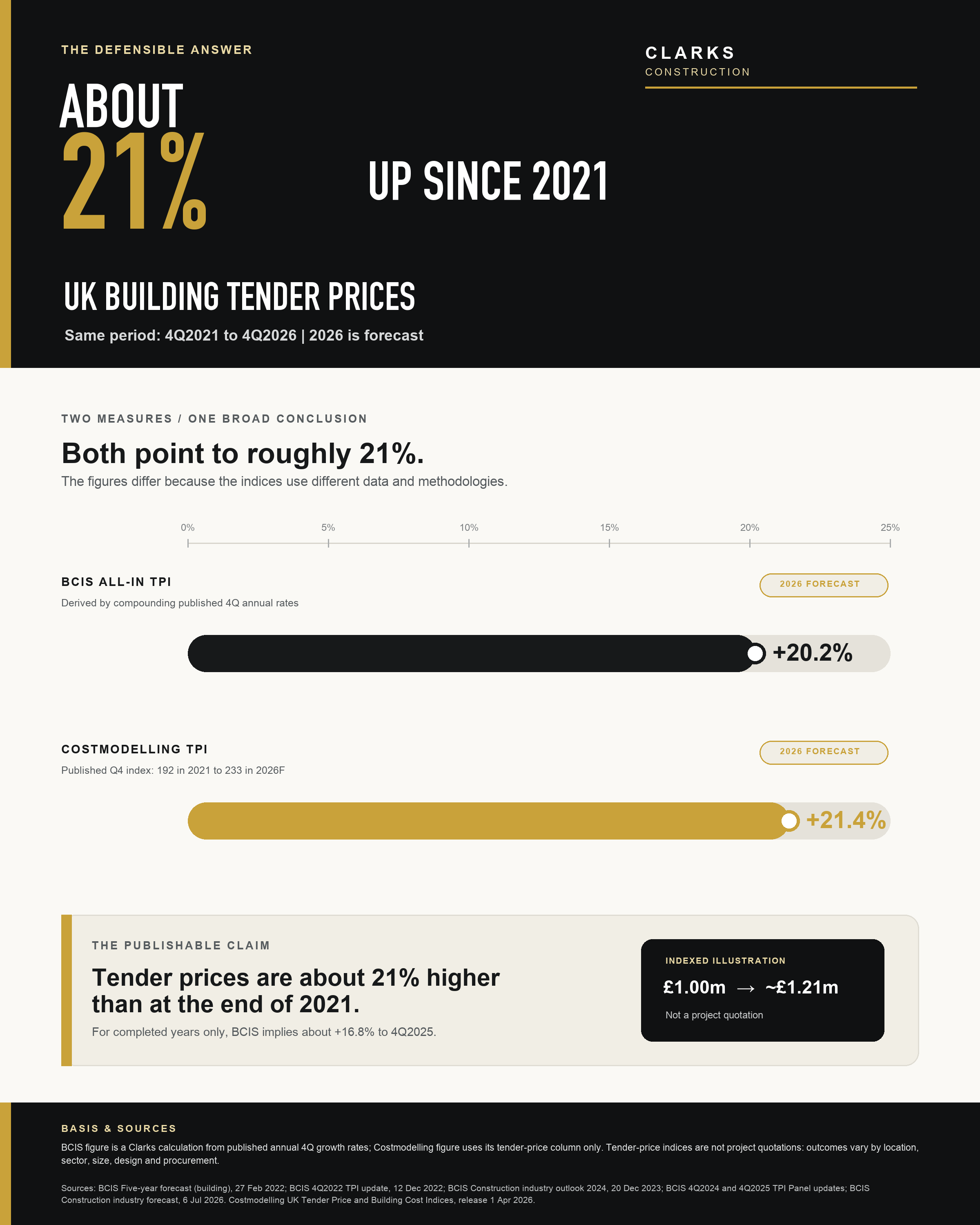
UK construction tender prices are forecast to finish 2026 around 22% higher than they were at the end of 2021.
But that increase did not come from one simple inflation spike - and it was not caused by building materials alone.
The industry has experienced several overlapping waves of pressure: COVID-19 disruption, global supply-chain problems, Russia's invasion of Ukraine, sharply higher energy costs, skilled-labour shortages, wage increases and changes to employers' National Insurance.
Understanding those pressures matters. Tender price inflation affects when projects remain viable, how much contingency clients require and whether the price submitted can still deliver the project when construction begins.
First, what does "around 22%" mean?
The Costmodelling UK Tender Price Index records:
- 4Q2021: 192
- 3Q2026: 233
- Forecast 4Q2026: 234
Moving from 192 to 233 represents an increase of approximately 21.4%. If the forecast 4Q2026 index of 234 is reached, the increase from 4Q2021 will be approximately 21.9%.
These percentages are our calculations from Costmodelling's published quarterly indices - not percentages published directly by Costmodelling.
The 4Q2026 figure is also a forecast, not an observed result.
BCIS provides a useful primary-source cross-check. Its All-in Tender Price Index recorded annual tender price growth of 3.2% in 2Q2026. BCIS subsequently forecast tender prices to increase by 2.9% during 2026.
These figures answer different questions. The 21.9% figure measures the cumulative movement from the end of 2021 to forecast year-end 2026. The BCIS figure measures the latest annual rate of inflation.
Wave one: COVID-19 disrupted supply and productivity
The first major pressure came from the COVID-19 pandemic.
Manufacturing interruptions, port congestion and unreliable international shipping made construction materials more difficult - and more expensive - to obtain. When economies reopened, demand recovered faster than many supply chains could respond.
UK projects were competing for steel, timber and other essential products in a global market already struggling with shortages and longer delivery periods.
Conditions on construction sites changed too. Social-distancing requirements affected how closely trades could work together, while Test and Trace absences reduced the availability of labour. Contractors had to manage additional welfare, sequencing and site-management requirements.
BCIS reported that construction-material cost inflation reached a 40-year high during 2021. It attributed the pressure to the pandemic, global demand and logistics difficulties. Brexit added further friction to both trade and labour availability.
The result was not just a higher price for individual products. Contractors also faced reduced productivity, uncertain lead times and a greater risk that the cost allowed at tender stage would change before an order was placed.
That uncertainty had to be reflected somewhere in the tender.
Wave two: Russia's invasion of Ukraine created an energy shock
In February 2022, Russia launched its full-scale invasion of Ukraine.
The war placed further pressure on European energy and commodity markets. Gas, electricity, fuel and transport costs increased, with consequences throughout the UK construction supply chain.
This mattered because many construction products are extremely energy-intensive to manufacture.
Steel must be processed at very high temperatures. Cement, bricks and glass require significant heat. Insulation, aluminium products and roof membranes also depend on energy, oil-based inputs or energy-intensive manufacturing processes.
Higher fuel prices increased the cost of operating plant, transporting materials and making deliveries to site.
According to BCIS, the supply-chain disruption originating during COVID-19 pushed construction-material inflation to a peak of 26% in June 2022. Russia's invasion added further pressure to energy prices, commodity prices and material availability.
Even when the most extreme rates of materials inflation began to ease, the underlying price level did not return to where it had been in 2021.
Inflation slowing from 20% to 3%, for example, does not mean prices have fallen. It means they are still increasing, but more slowly.
That distinction is central to understanding why current tenders remain significantly above their pre-crisis equivalents.
Wave three: labour and employment costs increased
As materials inflation moderated, labour became a more prominent source of pressure.
Construction continues to face shortages across a range of skilled occupations. When suitable workers and subcontractors are difficult to secure, wages and subcontract prices tend to increase.
BCIS reported annual site-wage inflation of 12.8% in 3Q2022. Contractors were therefore dealing with higher materials prices and rapidly increasing labour costs at the same time.
Further employment-cost changes arrived in April 2025.
The National Living Wage for workers aged 21 and over increased by 6.7%, from £11.44 to £12.21 an hour.
Employer National Insurance also changed from 6 April 2025:
- The employer contribution rate increased from 13.8% to 15%.
- The annual secondary threshold fell from £9,100 to £5,000.
- The maximum Employment Allowance increased to £10,500, mitigating some of the additional cost for eligible employers.
For many construction businesses, particularly labour-intensive contractors and subcontractors, the combined effect increased the cost of employing each worker.
The hourly wage is only part of that calculation. Employers must also consider National Insurance, pensions, holiday pay, training, travel, supervision, welfare and other employment-related overheads.
Those costs ultimately influence subcontract quotations and main-contractor tenders.
Why input costs do not translate directly into tender prices
A 10% increase in construction inputs does not automatically produce a 10% increase in tender prices.
Tender prices are also shaped by:
- The number of contractors competing for a project
- The strength of contractors' order books
- Local and sector-specific demand
- Project size, specification and complexity
- Procurement route and contract conditions
- Programme length and anticipated start date
- The allocation of inflation and design risk
- Contractors' overheads, margins and appetite for the work
When workloads are limited, contractors may absorb some cost pressure to secure projects. When order books are strong or specialist capacity is constrained, more of that pressure is likely to be passed to clients.
BCIS reported in 2Q2026 that subdued demand and competitive tendering were limiting how much higher input costs could be reflected in tender prices. However, it also warned that squeezed margins, skilled-labour shortages, fuel costs, regulatory delays and supply-chain insolvency remained concerns.
This is why different tender-price forecasts can legitimately produce different results. They may use different project samples, dates, sectors, locations and assumptions about future demand.
Does a 22% index increase mean every project costs 22% more?
No.
A tender-price index describes movement across a defined sample of the market. It does not mean that every project has experienced exactly the same increase.
The effect on an individual scheme depends on its location, specification, material mix, labour requirements, procurement strategy and timing.
A steel-intensive industrial building may have experienced different pressures from a refurbishment with a high proportion of specialist labour. A project tendered competitively during a quiet period may also achieve a different result from one requiring scarce specialist contractors.
The index should therefore be treated as a market benchmark - not a substitute for a project-specific cost plan.
What this means for clients
The market may be more stable than it was at the height of the COVID-19 and energy shocks, but stable does not mean inexpensive.
Budgets prepared using historic rates can quickly become unreliable if the base date, tender date and construction programme are not clearly identified.
Clients can manage that risk through:
- Early contractor and supply-chain engagement
- Current market testing of significant work packages
- Realistic allowances for tender price inflation
- Clear identification of long-lead materials
- Sensible allocation of inflation and programme risk
- Procurement routes appropriate to current market conditions
- Regular cost-plan reviews as the design develops
At Clarks Construction, we believe a robust tender is about more than producing the lowest figure on the day.
It should identify risk early, test assumptions, challenge unnecessary cost and give the client confidence that the submitted price reflects the project that will actually be delivered.
Tender prices have risen considerably since 2021. Understanding why they increased is the first step towards managing what happens next.
Sources and methodology
- Costmodelling, "UK Tender Price and Building Cost Indices", released 1 July 2026. Indicative secondary-source index; calculations from quarterly tender-price figures are our own.
- BCIS, "Construction Industry Forecast - 2Q2026 to 2Q2031", published 6 July 2026.
- BCIS, "Tender Price Index: Estimate of Tender Price Inflation, 2Q2026", published 29 June 2026.
- BCIS, "A Review of the Construction Industry 2022", published 16 January 2023.
- BCIS, "Building Materials Cost Increases Reach 40-Year High", published 17 November 2021.
- GOV.UK, "Changes to Employer National Insurance Contributions", published 13 November 2024.
- Low Pay Commission, "National Living Wage Increases to £12.21", published 28 March 2025.